
(MWC)
Mega Watt Charging
is a high-power charging standard designed for heavy-duty electric vehicles, delivering up to 3.75 MW (3,000 Amps at 1,250 Volts ) to drastically reduce charging times for trucks, buses, ships, and aircraft. It enables charging large batteries in 20-30 minutes, allowing commercial vehicles to recharge during mandated driver breaks.
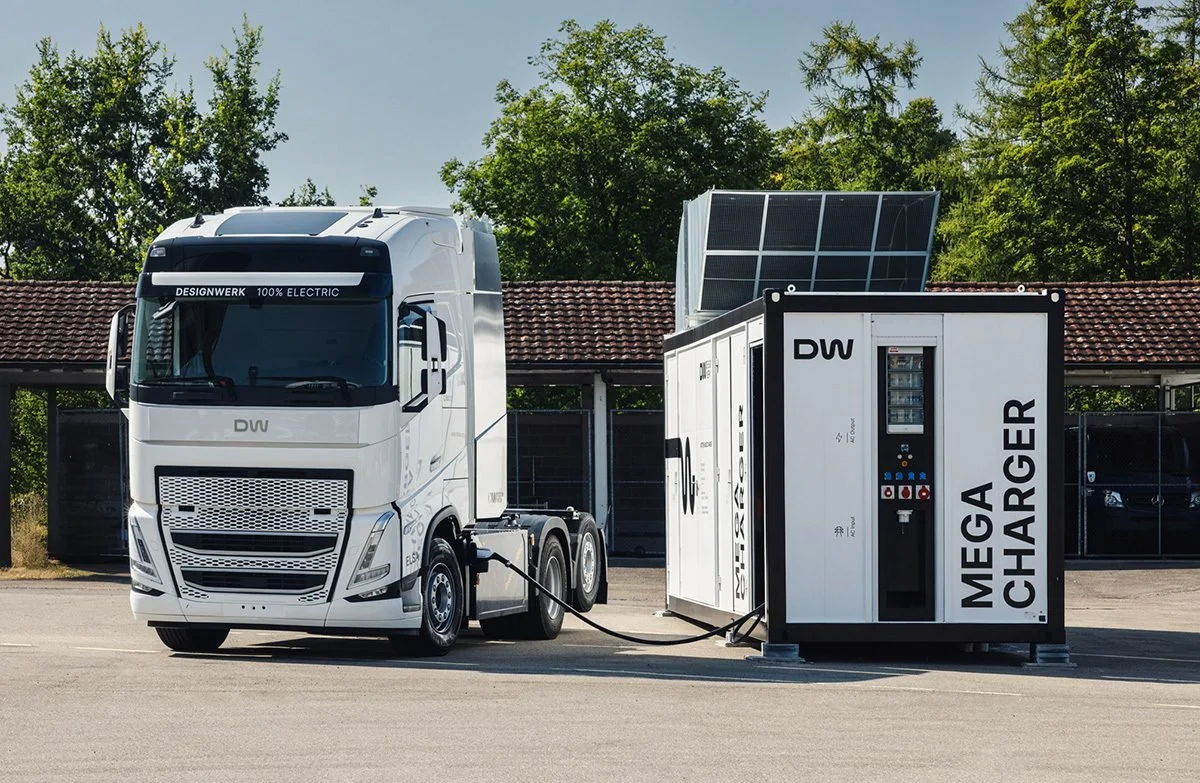
Key Aspects of Megawatt Charging Systems
Purpose & Power: MCS specifically targets heavy-duty transport, providing much higher charging speeds than conventional CCS (Combined Charging System), with capabilities ranging from 1 MW to over 3 MW.
Standards & Connector: The system uses a specialized single-conductive, touch-safe plug designed for high durability and interoperability.
Speed: A 1000 kWh battery can be fully charged in approximately 20-30 minutes.
Grid and Power: While requiring significant infrastructure, MCS uses dynamic power sharing to manage energy, with charging hardware often, capable of up to 1.2 MW initially.
Applications: Primarily designed for long-haul trucks, it also supports electric maritime vessels, mining equipment, and electric aircraft (VTOLs).
Key Players and Development
ChargeTronix has a 1.28 MW charging station that has 360 and 480 dispenser options
Milence is implementing MCS to change heavy-duty transport, according to their insight.
Volvo Trucks highlights that MCS allows for much faster charging speeds, as they detailed in this article.
Kempower is producing systems with up to 1.2 MW, according to their product description.
Eaton discusses the implications for grid stability in this article.
Terawatt Infrastructure is building out sites to support this technology, as described in this blog post.
The Megawatt Charging System (MCS) is a charging connector under development for large battery electric vehicles.
The MCS connector is the current front runner for a connector to become a worldwide standard charging connector for large and medium commercial vehicles.
History
A task force was formed by industry actors in March 2018, with the purpose to "define a new commercial vehicle high power charging standard to maximize customer flexibility. From early 2018 until late 2019, the abbreviation HPCCV (High Power Charging for Commercial Vehicles) was used, following the name of the CharIN consortium taskforce. The purpose statement was later revised to "work out requirements for a new commercial vehicle high power charging solution to maximize customer flexibility when using fully electric commercial vehicles. The scope of the technical recommendation is to be limited to the connector, and any related requirements for the EVSE, the vehicle, communication, and related hardware.
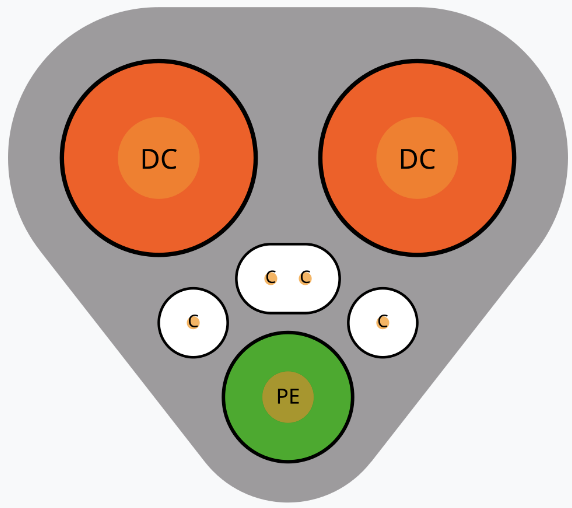
The HPCCV held a meeting in September 2018 to build consensus on proposed requirements, and the CharIN Board of Management approved a set of consensus requirements in November 2018. Five companies submitted candidate designs to meet the requirements: Tesla, Electrify America, ABB, EVgo, and ChargeTronix. HPCCV selected a charging plug and socket design in May 2019, which was endorsed by CharIN leadership in September 2019. The version 1.0 HPCCV connector had a triangular shape and round power pins, but the design required further development as it was not finger-proof (safe from accidental contact with the power pins).
Approximate drawing of previous version 2 draft outlet; DC± would have been carried via two "tuning fork" contacts
A test of seven vehicle inlets and eleven connectors was held at the US National Renewable Energy Laboratory (NREL) in September 2020. The prototype hardware represented designs from seven different manufacturers, and six additional manufacturers participated virtually. Criteria evaluated included fit/compatibility, ergonomics, and thermal performance. Evaluations at maximum current (3000 A) were conducted with cooling of both the inlet and the connector; for connector cooling only, current was limited to 1000 A, and without cooling, current was limited to 350 A.Versions 2.0 through 2.4 of the MCS connector used "hairpin" shaped contacts, but it was later changed to version 3.0 through 3.2, which returned to the triangular shape with larger pins and longer protective sheaths to prevent accidental contact.
The task force had anticipated that a requirements and specification document would be published by the end of 2021. In August 2021, prototype connectors were tested at up to 3.75 megawatts. MCS connector version 3.2 was adopted in December 2021. CharIN intends to complete the specification document by 2024, which is planned to be in a state that is ready to be adopted by ISO and IEC as a global standard. In preparation, SAE International, began developing the draft MCS standards into the J3271 requirements in December 2021; in parallel, the IEC began developing standard 63379 in Spring 2021.
The final standard is expected to be resolved in 2025 with the publication of the system standard documents IEC 61851-23-3 and SAE J3271. (SAE J3271 has been published in March 2025) The charging communication is implemented by using automotive Single-pair Ethernet 10BASE-T1S (according IEEE 802.3-2022 and ISO 15118-10) as physical layer and ISO 15118-20 as application protocol (the latter allows state of the art cybersecurity implementation and smart charging services like V2G (bidirectional charging) and the automated billing & authentication method Plug & Charge (PnC)).