
Permitting | Procurement
Permitting and procurement for Urban Air Mobility (UAM) are currently navigating a transition from conceptual planning to active, regulatory-supported deployment, primarily driven by Federal Aviation Administration (FAA) initiatives and federal funding guidelines with the National Airspace System (NAS).
At the federal level, the FAA is leading efforts to integrate AAM. FAA is developing the safety and certification standards for AAM aircraft, pilot training requirements, and standards for the design and siting of vertiports. FAA is also updating the various air traffic control and navigation systems to handle the integration of AAM into NAS.
As part of this broader work, FAA has published a variety of AAM-related planning resources, including the AAM Implementation Plan (also referred to as “Innovate28”), an Engineering Brief on Vertiport Design Standards, and an Urban Air Mobility Concept of Operations. Additionally, FAA established regulations for the operation of AAM and certification standards for AAM and pilots as outlined in the FAA’s 2024 Final Rule for Integration of Powered-Lift.
Infrastructure and Operational Requirements
Permitting Vertiports: AAM infrastructure requires site-specific permitting, with early efforts focusing on modifying existing airports and heliports, guided by FAA engineering briefs.
Regulatory Support: The AAM National Strategy (2026–2036) aims to align federal policies with local efforts to accelerate deployment.
Procurement Process: AAM stakeholders, including local governments, must follow structured procurement, including preparing requests for qualifications (RFQ) and evaluating bidders, for infrastructure and planning services.
Key Initiatives and Partnerships
Agility Prime: The U.S. Air Force's Agility Prime program acts as a catalyst for the commercial market by using government procurement to test and validate eVTOL vehicles for missions like logistics and disaster response.
State-Level Action: Between 2021 and 2025, 21 states introduced legislation related to vertiports, with 24 bills enacted to address planning, safety, and operational standards.
For organizations involved in AAM procurement, the FAA emphasizes the need to consult early regarding AIP eligibility to avoid compliance.
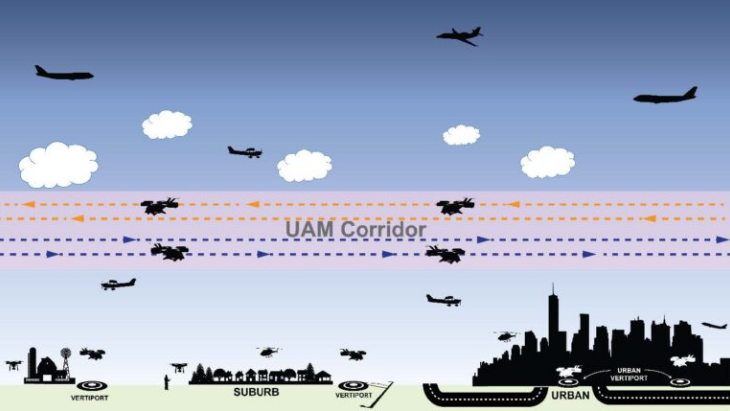
As AAM become more prevalent in the NAS, dedicated corridors will need to be developed to help stratify their operations from traditional fixed-wing aircraft and helicopters. Illustration by FAA/Urban Air Mobility Concept of Operations.
Aligned with FAA’s efforts, the U.S. Department of Transportation (DOT) developed a National Strategy and Plan for AAM developed through the AAM Interagency Working Group (AAM IWG).The AAM IWG was established by Congress as part of the Advanced Air Mobility Coordination and Leadership Act (Public Law No: 117-203) to plan and coordinate efforts related to safety, operations, infrastructure, physical security and cybersecurity, and federal investment necessary for maturation of the national AAM ecosystem, particularly passenger-carrying aircraft.
Federal Permitting and Procurement Framework
AIP Funding Guidelines: Procurements for AAM infrastructure (e.g., vertiports) funded by the Airport Improvement Program (AIP) must adhere to 2 CFR part 200, which sets standards for competitive bidding, equipment acquisition, and professional services.
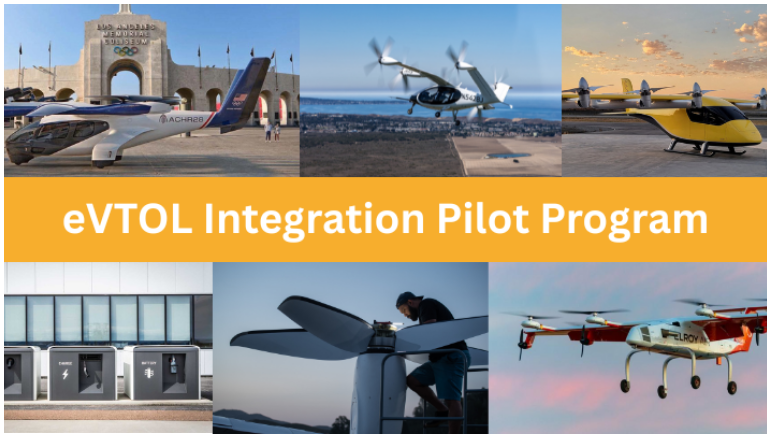
eVTOL Integration Pilot Program (eIPP): The FAA issued a Screening Information Request (SIR) on Sept. 12, 2025, for the eIPP, inviting state, local, tribal, and territorial (SLTT) governments to propose projects using electric Vertical Takeoff and Landing (eVTOL) aircraft. Proposals for this program were due in late 2025, with plans to select at least five pilot projects to accelerate integration.
Noncompetitive Procurement: Utilizing noncompetitive (sole source) methods for AIP-funded AAM projects requires prior FAA approval, and such actions must be conducted separately from other AIP-eligible procurements.